
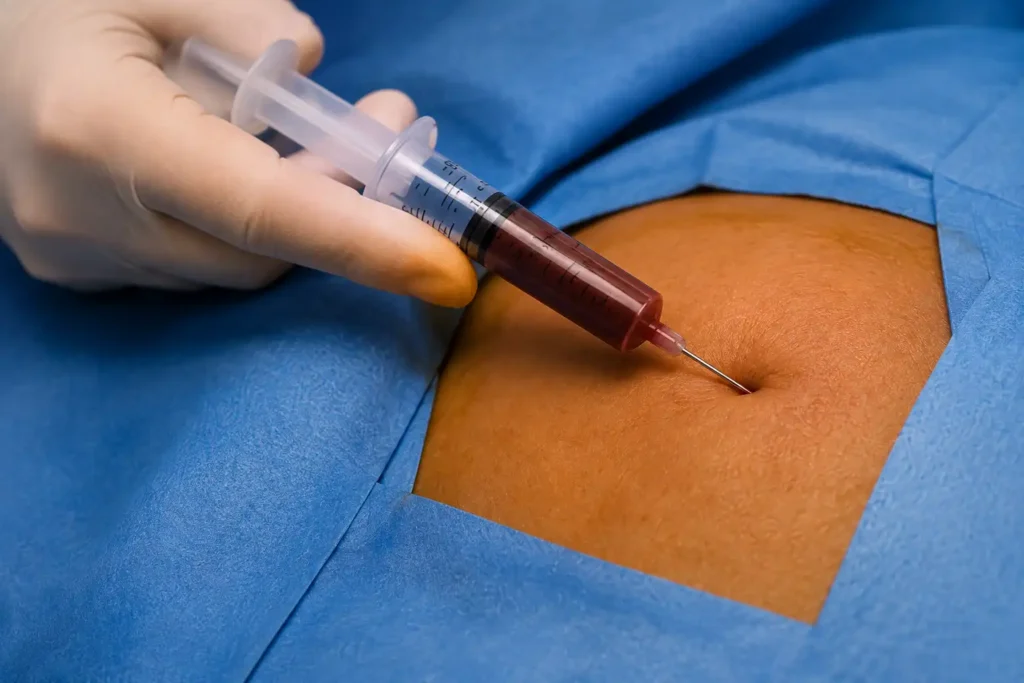
A number of studies purport to demonstrate the efficacy of bone marrow aspirate (BMA) or bone marrow concentrate (BMAC) as an alternative to autologous cancellous bone graft in osteogenesis. It is important to consider that many of these studies utilize cancellous autograft, allograft, and/or local bone as a supplement to BMA or BMAC without a control cohort, so the benefit (in these specific studies), if any of BMA or BMAC alone to the subsequent bone formation is unknown.
The concentration of mesenchymal stem cells (MSCs) from the bone marrow (typically the pelvis) for BMA or BMAC use is dependent upon the individual patient and the method of aspiration. Muschler it al ¹ found considerable variability in the concentration of MSCs among 42 patients (ages 14-77) with respect BMA cell cultured and labeled for alkaline phosphatase-positive colony-forming units. The authors also found that aspirating more than 2 cc from any given location resulted in significant dilution from peripheral blood. “An increase in the aspiration volume from one to four milliliters caused a decrease of approximately 50 per cent in the final concentration of alkaline phosphatase-positive colony-forming units in an average sample.” ¹
In addition, Patterson et al² found that the concentration of MSCs (per volume) in BMA is generally about 1/3 that of cancellous bone from the same individual. These authors also found that the osteoprogenitor cells were 11.4 times more abundant in the cells bound to the trabecular surface (requiring enzymatic digestion to free) versus those readily dissociated by mechanical means from the marrow space.
There have been two recent systematic literature review studies examining the efficacy of BMA or BMAC. These studies conclude that the heterogeneity of the studies do not allow for one to make conclusions regarding the efficacy of these therapies in enhancing bone formation.
In a systematic review study authored by Singh et al ³, 55 studies qualified for review. All studies involved the use of BMA (not BMAC) as a standalone intervention. The study’s conclusion: “While union rates are encouraging, the absence of control groups across all included studies means that the contribution of BMA to these outcomes cannot be determined.”
Moyal et al ⁴ in a separate systematic review study, qualified twenty-five studies for review. These papers evaluated both BMA and BMAC for long bone nonunions. “The current literature pertaining to use of BMA/BMAC for nonunion is extremely heterogeneous in terms of patient population and concomitant treatment modalities. While results are promising for use of BM/BMAC with other gold standard treatment methodologies, the literature requires additional Level I data to clarify the impact of role BMA/BMAC in treating nonunion when used alone and in combination with other modalities.”
- G F Muschler 1, C Boehm, K Easley, Aspiration to obtain osteoblast progenitor cells from human bone marrow: the influence of aspiration volume,
J Bone Joint Surg Am. 1997 Nov;79(11):1699-709 - Patterson TE et al, The Efficiency of Bone Marrow Aspiration for the Harvest of Connective Tissue Progenitors from the Human Iliac Crest, J Bone Joint Surg Am. 2017 Oct 4;99(19):1673-1682
- Tejeshwer Singh et al, Autologous bone marrow aspirate as a standalone treatment in patients with impaired fracture healing: A scoping review, Injury, Volume 57, Issue 8, August 2026
- Moyal et al, Bone marrow aspirate and bone marrow aspirate concentrate: Does the literature support use in long-bone nonunion and provide new insights into mechanism of action? European Journal of Orthopaedic Surgery and Traumatology, Volume 34, pp 2871-2880 (2024)